






What Does “Service Engine Soon” Mean? How to Tell If It’s a Fault or a Reminder
The words “Service Engine Soon” can mean two very different things depending on your car. In some vehicles it is simply another name for the check engine light, which means the engine computer has detected a fault. In others, a “service soon” or “maintenance required” message is only a reminder that an oil change or routine service is due. Most articles blur these together. This guide shows you how to tell which one you have in about a minute, how urgent it is, and what to do next.
The Short Answer
- If your dashboard says “Service Engine Soon” or “Check Engine” (or shows an engine outline): treat it as a warning from the engine and emissions computer. A fault has been detected and stored as a code.
- If it says “Maintenance Required,” “Maint Reqd” or “Service Due”: it is usually a scheduled-service reminder, often for an oil change, not a fault.
- If it flashes: this is more serious. Reduce speed and engine load and get to a shop as soon as it is safe.
- If it is steady and the car drives normally: you can usually keep driving short distances while you get the code read, but do not ignore it for weeks.
- A loose gas cap is the cheapest and most common first thing to check.
Step 1: Which Light Do You Actually Have?
Car makers use different wording, and the same words are not always used the same way. Use this quick test.
- Read the exact wording and look at the symbol. “Service Engine Soon,” “Check Engine,” “Check Powertrain” or an engine outline are generally the fault warning. “Maintenance Required,” “Maint Reqd” and “Service Due” are generally reminders.
- Look for a second light or message. Many cars have both a fault light and a separate maintenance reminder. If you see only a text message in the information display, such as “service due,” it is probably the reminder.
- Think about when you last had service. A reminder tends to come on at a set mileage or after a set time since the last reset. If you are near your usual oil change interval, a reminder is likely.
- Get the car scanned. Many auto parts stores will read the stored codes for free. If there is a stored code, you have a fault. If there are no codes and the message is about service, it is probably the reminder.
- Check your owner’s manual. It tells you exactly what each light on your car means.
Some sources say the service engine soon light can come on for an oil change reminder, and others say an oil change alone will not turn it on. Both can be true, depending on how the car maker set up the dashboard, which is why the manual and a scan matter more than a general rule.
What the wording usually means
| Wording on the dash | Usually means | Typical action |
|---|---|---|
| Service Engine Soon / Check Engine / Check Powertrain | Fault stored by the engine computer | Get the code read soon |
| Engine outline symbol | Same as check engine | Get the code read soon |
| Maintenance Required / Maint Reqd (for example on Toyota and Lexus) | Scheduled service reminder, often oil and filter | Do the service, then reset the reminder |
| Service Due / Service Soon | Often a reminder, but wording varies by maker | Check the manual and consider a scan |
A reminder of this kind does not mean a fault. It does not affect how the car drives, but it is there so you do not skip routine service.
Step 2: How Urgent Is It?
| What you see | What it likely means | What to do |
|---|---|---|
| Steady light, car drives normally | A fault has been stored; often minor or emissions-related | Get the code read within days; avoid hard driving and long trips |
| Flashing light | An active engine misfire is possible; this can damage the catalytic converter | Reduce speed and load, avoid highway speeds, and get to a shop soon |
| Light plus overheating, loss of power, smoke or a strong smell | Possibly serious | Pull over safely and shut off the engine; call for help |
| Light plus red oil pressure or temperature warning | Possible engine damage risk | Stop safely; do not keep driving |
| Maintenance reminder only, no fault code | Service is due | Schedule service; reset after |
About color: dashboards differ, but amber or yellow usually means caution (get it checked soon) while red usually means stop and act now. If your car shows a red warning together with an engine light, treat it as urgent and consult the manual.
How far can you drive? A steady light with normal driving usually allows short trips to get the code read. The worry is a flashing light, because a misfire can send unburned fuel into the exhaust and damage the catalytic converter. Original-equipment converters can cost well over a thousand dollars, in some cases as much as $1,800, so a quick scan early is cheaper than waiting.
Step 3: Check the Easy Things First
- Gas cap: a loose, cracked or missing cap can leak fuel vapor and trigger the evaporative emissions (EVAP) system. Tighten it until it clicks. The light may not go out right away. It can take some driving for the car to re-run its tests. A replacement cap is often around $10.
- Recent fill-up: if the light appeared right after fueling, the cap is the first suspect.
- Driving behavior: note any rough idle, hesitation, poor fuel economy or unusual noise. This helps the shop.
- Fluids and other lights: check for low oil, low coolant or other warnings.
Step 4: Get the Code
The computer stores a diagnostic trouble code (DTC) that points to the area with the problem.
- Free scans: many parts-store chains, including AutoZone, Advance Auto Parts and O’Reilly, offer free code reading for compatible cars.
- Your own scanner: basic Bluetooth OBD-II readers are inexpensive, and more advanced tools cost more.
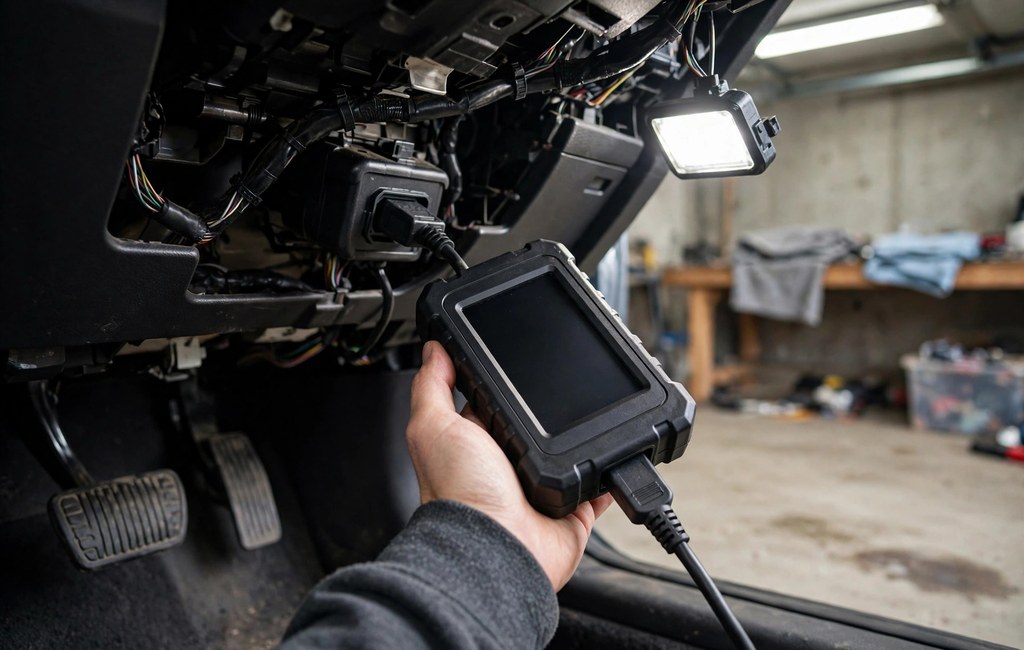
- The port: it is usually under the dashboard on the driver’s side.
A code is a clue, not a diagnosis. A scan tells you which system or sensor the computer flagged. It does not always tell you why. A shop uses tests to find and verify the root cause. Replacing parts based on a code alone can waste money.
A generic reader has limits. Some codes and some systems, such as transmission or brake controllers, may not be visible to a basic scanner.
Common codes you may see
These are standard generic codes. Confirm what a code means for your specific car before spending money.
| Code | General meaning | Often related to |
|---|---|---|
| P0440, P0441, P0442, P0455 | Evaporative emissions system problems | Gas cap, EVAP hoses and valves |
| P0300 to P0308 | Misfires | Spark plugs, coils, fuel or compression issues |
| P0171, P0174 | System too lean | Air leaks, dirty mass airflow sensor, fuel delivery |
| P0420, P0430 | Catalyst efficiency below threshold | Aging catalytic converter or exhaust sensors |
| Oxygen sensor codes (for example P013x, P015x) | Sensor not reading correctly | Failing oxygen sensor |
Common Causes of a Fault Light
- Loose or faulty gas cap
- Failing oxygen sensor
- Dirty or failing mass airflow sensor
- Worn spark plugs or ignition coils causing misfires
- Failing catalytic converter
- EVAP system leaks
- Other engine sensors or emission components
Some of these have no obvious effect on how the car drives, but they can hurt fuel economy and will cause an emissions test failure.
What It Costs

| Step | Typical cost |
|---|---|
| Gas cap | Often around $10 |
| Code read at a parts store | Free at many chains |
| Professional diagnosis | Varies by shop and by how complex the problem is; some shops charge for testing beyond a simple code read |
| Common repairs | Vary widely by car and problem; get a written estimate |
| Catalytic converter (worst case) | Can be well over $1,000 for original equipment |
Ask the shop what test confirms the problem before you approve parts, and get an estimate in writing.
Don’t Just Clear the Light
It is tempting to clear the code or disconnect the battery to make the light go away. Be careful.
- If the problem is not fixed, the light will come back.
- Clearing codes resets the car’s emissions readiness monitors. These are self-tests the computer runs before an emissions inspection. After a reset, the car needs to be driven through a mix of city and highway conditions so the tests can complete.
- Disconnecting the battery can have the same effect.
- If you have an inspection coming, you could arrive with monitors not ready and be turned away or fail.
Best practice: fix the cause first, then clear the code, then drive normally for a few days before the inspection. A shop will often re-scan after a repair to confirm the light stays off and the monitors set.
If It’s Only a Maintenance Reminder
A reminder does not mean something is broken. It is a prompt to do routine service.
- Do the service: an oil and filter change is the most common one. Check your manual for the interval and for other items due.
- Reset the reminder afterward. If you do not, the light may stay on or the system may not remind you at the right time later. The reset steps differ by car, often a button combination, a menu in the display or a scan tool. Your manual has the exact procedure.
- Do not reset it without doing the service. That defeats the purpose and can lead to missed maintenance.
- Some reminders are based on mileage or time, not oil condition. Many cars cannot tell fresh oil from old oil on their own.
Older Cars and Different Systems
In the US, cars from 1996 onward use the standardized OBD-II system, which is what parts-store scanners are built for. Older cars use earlier systems and may need different tools. Some older cars let you read codes by counting the flashes of the light after grounding a test terminal, which is a procedure specific to each car. If your car is older, check the service manual for your model before trying anything.
Quick Checklist
- Read the exact wording and note the symbol and color.
- Check whether the light is steady or flashing.
- If it is flashing, or the car runs badly, overheats or smokes, slow down and get help.
- Tighten the gas cap and note when the light appeared.
- Check the owner’s manual for what the light means.
- Get the code read for free if you can.
- Ask the shop what test confirms the cause before approving repairs.
- Do not clear the code before an emissions inspection without fixing the cause.
- If it is only a reminder, do the service and reset it.
Frequently Asked Questions
What does service engine soon mean?
Usually that the car’s computer has detected an engine or emissions problem and stored a code. On some cars, similar wording is a maintenance reminder instead.
Is service engine soon the same as check engine?
On many cars, yes. It is simply a different label for the same warning. Some cars also have a separate maintenance reminder with similar wording, so check the manual.
Can I keep driving with the service engine soon light on?
If it is steady and the car drives normally, short trips to get it checked are usually fine. If it flashes or the car runs badly, reduce speed and get to a shop.
Will the light turn off by itself?
Sometimes, after the problem is fixed or goes away and the computer completes its tests over several drives. A stored code and a persistent fault will keep it on.
Can an oil change turn it on or off?
It depends on the car. A maintenance reminder can be tied to oil change intervals and must be reset after service. A fault light is not turned off by an oil change.
How much does it cost to fix?
It ranges from about $10 for a gas cap to well over a thousand dollars for a catalytic converter. Get the code and an estimate before deciding.
Why does the light come back after I clear it?
Because the underlying problem is still there. Clearing the code does not fix the cause.
Can I pass an emissions test right after clearing the code?
Usually not. The readiness monitors need time and driving to complete again.
Bottom Line
“Service Engine Soon” is either a fault warning from your engine computer or, on some cars, a maintenance reminder. To find out which, check the wording and your owner’s manual, then get the code read. A steady light on a car that drives normally can wait a few days, but a flashing light, rough running, overheating or smoke cannot. Check the gas cap first, get the code, and don’t just clear the light before an inspection. If it is only a reminder, do the service and reset it.
