





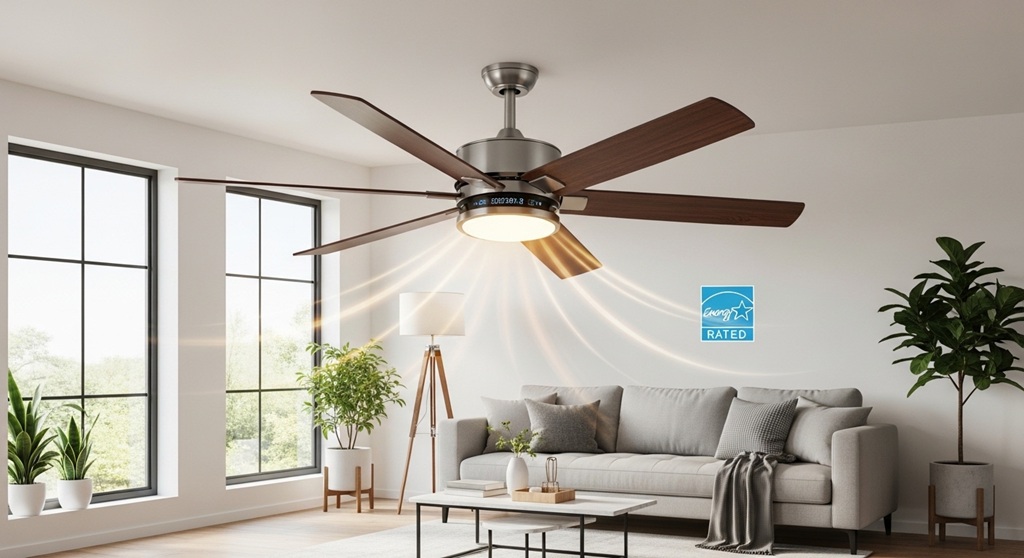
How to Choose the Best Energy‑Efficient Ceiling Fans
Electricity bills are rising across many regions, and cooling a home can account for a significant share of household energy use. Many homeowners search for practical ways to reduce costs without sacrificing comfort. One often overlooked solution is choosing the right ceiling fan.
Energy-efficient ceiling fans use improved motor technology, optimized blade design, and better airflow performance to move more air while consuming less electricity. According to the U.S. Department of Energy, using ceiling fans can allow homeowners to raise thermostat settings by about 4°F without reducing comfort, which helps lower cooling costs.
But not all ceiling fans deliver the same efficiency. Some models use outdated motors, poor blade design, or inefficient airflow patterns that waste energy. Choosing the wrong fan may result in higher electricity use and poor cooling performance.
This guide explains how to choose energy-efficient ceiling fans using clear criteria such as airflow efficiency (CFM), motor type, blade design, and ENERGY STAR certification. You will also learn how to match fan size to room dimensions, compare modern motor technologies, and avoid common buying mistakes.
By the end of this guide, you will know exactly what to look for when selecting a ceiling fan that reduces energy consumption while keeping your space comfortable.
What Is an Energy-Efficient Ceiling Fan?
Short answer: An energy-efficient ceiling fan is a fan designed to deliver higher airflow (CFM) while using less electrical power (watts), typically through improved motors and blade engineering.
Energy efficiency in ceiling fans is measured by how much airflow the fan produces compared to the electricity it consumes. This is commonly expressed as CFM per watt.
CFM stands for cubic feet per minute and represents the amount of air the fan moves. A higher CFM per watt ratio means the fan delivers more cooling airflow while using less energy.
Energy-efficient fans generally include several design improvements:
- High-efficiency motors such as DC motors
- Optimized blade angles and aerodynamic blade shapes
- Balanced airflow distribution
- Smart speed controls and timers
- ENERGY STAR certification
According to ENERGY STAR data, certified ceiling fans can be up to 60% more efficient than conventional fan models. This makes them a practical option for households seeking energy savings and improved airflow.
Why Should You Choose an Energy-Efficient Ceiling Fan?
Short answer: Energy-efficient ceiling fans reduce electricity consumption, improve airflow comfort, and help lower cooling costs.
Many people assume ceiling fans cool the air, but fans actually cool people by increasing evaporation of moisture from the skin. This creates a wind-chill effect that makes the room feel cooler.
Because of this effect, homeowners can raise thermostat settings when fans are running. Even a small increase in thermostat temperature can reduce air-conditioning energy use.
Several benefits make energy-efficient fans worth considering:
Lower electricity consumption
A traditional ceiling fan can use 70–90 watts of power. High-efficiency DC motor fans may use only 20–30 watts at similar airflow levels.
Reduced air-conditioning demand
The U.S. Department of Energy states that using ceiling fans allows homeowners to increase thermostat settings by up to 4°F while maintaining comfort.
Longer lifespan
Energy-efficient motors produce less heat and mechanical stress, which often increases product lifespan.
Quieter operation
DC motor fans generally operate more quietly than traditional AC motor fans.
These advantages make energy-efficient ceiling fans a practical upgrade for homes, offices, and apartments.
How Do You Measure Ceiling Fan Efficiency?
Short answer: Ceiling fan efficiency is measured using airflow (CFM), power consumption (watts), and airflow efficiency (CFM per watt).
When comparing ceiling fans, three technical specifications matter most.
| Metric | Meaning | Why It Matters |
|---|---|---|
| CFM | Cubic feet of air moved per minute | Shows airflow strength |
| Watts | Electrical power consumption | Indicates energy use |
| CFM/Watt | Airflow efficiency ratio | Measures overall efficiency |
A higher airflow efficiency ratio means better performance per watt of electricity used.
As a general guideline:
- Low efficiency: under 75 CFM/W
- Moderate efficiency: 75–100 CFM/W
- High efficiency: above 100 CFM/W
ENERGY STAR certified ceiling fans usually exceed these efficiency thresholds.
What Motor Type Is Best for Energy-Efficient Ceiling Fans?
Short answer: DC motors are the most energy-efficient motor type for ceiling fans.
Ceiling fans typically use one of two motor technologies.
AC Motors
AC motors are the traditional design used in most older ceiling fans. They are reliable but less efficient than newer motor types.
- Higher energy consumption
- More mechanical friction
- Limited speed control
DC Motors
DC motors use electronic controllers to regulate power more precisely. This design improves efficiency and reduces energy loss.
Benefits of DC motors include:
- Up to 70% lower energy use
- More speed options
- Quieter operation
- Reduced heat generation
Many modern energy-efficient ceiling fans use DC motors because they offer the best balance of airflow and power consumption.
How Does Blade Design Affect Ceiling Fan Efficiency?
Short answer: Blade shape, length, and pitch determine how effectively a fan moves air.
Fan blades function similarly to airplane wings. Their design determines how much air is pushed downward.
Three blade features influence airflow performance.
Blade Pitch
Blade pitch refers to the angle of the blades relative to the fan body.
Most efficient ceiling fans use a pitch between 12 and 15 degrees. This range provides strong airflow without increasing motor strain.
Blade Length
Longer blades move more air, but the correct length depends on room size.
Large rooms require larger blade spans to distribute airflow evenly.
Blade Shape
Aerodynamic blades reduce air resistance and turbulence. This improves airflow efficiency while lowering energy consumption.
High-quality fans often use precision-balanced blades to minimize vibration and improve airflow consistency.
How Do You Choose the Right Ceiling Fan Size for Your Room?
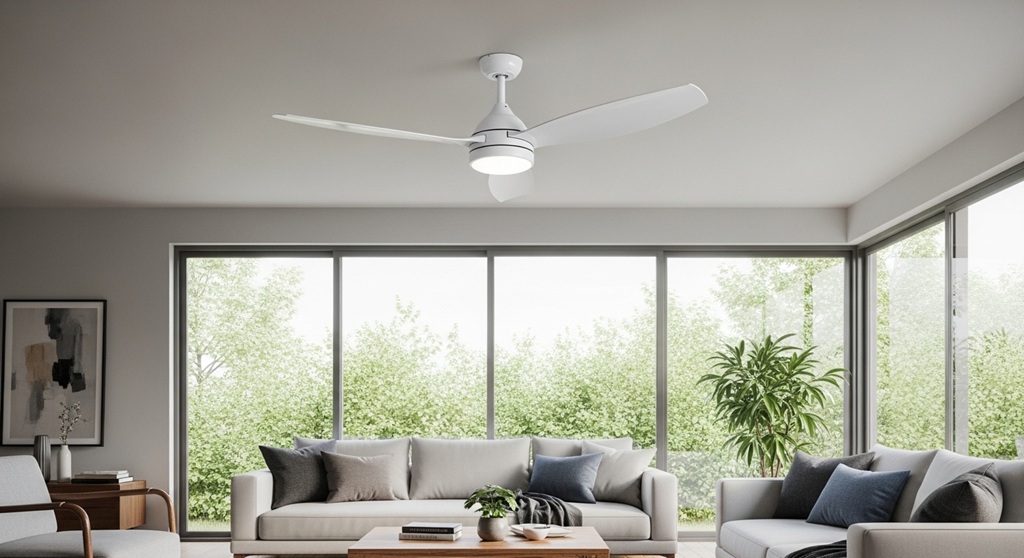
Short answer: The correct fan size depends on room dimensions, measured by square footage.
A ceiling fan that is too small cannot circulate enough air, while an oversized fan may create excessive airflow.
| Room Size | Recommended Fan Size |
|---|---|
| Up to 75 sq ft | 29–36 inches |
| 76–144 sq ft | 36–42 inches |
| 144–225 sq ft | 44 inches |
| 225–400 sq ft | 50–54 inches |
| Over 400 sq ft | 60 inches or larger |
Choosing the correct fan size ensures proper air circulation while maintaining energy efficiency.
What Does ENERGY STAR Certification Mean for Ceiling Fans?
Short answer: ENERGY STAR certified ceiling fans meet strict efficiency standards set by the U.S. Environmental Protection Agency.
To earn the ENERGY STAR label, ceiling fans must pass independent performance testing. These tests measure airflow efficiency, lighting efficiency, and standby power consumption.
ENERGY STAR fans are typically:
- Up to 60% more efficient than standard models
- Tested for airflow performance
- Designed with improved motor technology
Choosing an ENERGY STAR ceiling fan provides confidence that the fan meets recognized efficiency benchmarks.
What Features Improve Ceiling Fan Energy Efficiency?
Short answer: Smart controls, variable speeds, LED lighting, and reversible motors improve ceiling fan efficiency.
Modern ceiling fans often include features that enhance performance and reduce electricity use.
Variable Speed Control
Multiple speed settings allow users to adjust airflow while minimizing power consumption.
LED Lighting
Integrated LED lights consume significantly less electricity than traditional incandescent bulbs.
Reversible Motors
Reversible fans can operate in both summer and winter modes.
- Summer mode pushes cool air downward.
- Winter mode circulates warm air trapped near ceilings.
This feature helps improve year-round energy efficiency.
What Common Mistakes Should You Avoid When Buying Ceiling Fans?
Short answer: Avoid choosing fans based only on appearance, ignoring airflow ratings, or selecting the wrong size.
Several common mistakes reduce fan efficiency and comfort.
- Choosing style over airflow performance
- Ignoring CFM ratings
- Installing fans too close to ceilings
- Buying oversized or undersized fans
- Overlooking motor technology
Carefully reviewing technical specifications helps avoid these problems.
Conclusion
Choosing the right ceiling fan involves more than selecting a design that matches your interior. The most important factors include airflow efficiency, motor technology, blade design, and correct sizing for your room.
Understanding how to choose energy-efficient ceiling fans helps homeowners reduce electricity consumption while maintaining comfortable indoor airflow. Modern fans with DC motors, optimized blade pitch, and ENERGY STAR certification provide strong performance while using significantly less energy.
When evaluating ceiling fan options, always compare CFM ratings, wattage, and efficiency ratios. Selecting the right fan size for the room and using features such as reversible motors and smart controls can further improve performance.
If you are planning a home upgrade or replacing an older fan, consider investing in a high-efficiency model. The long-term savings in electricity costs and improved comfort make energy-efficient ceiling fans a practical and cost-effective solution.
Ready to upgrade your home’s airflow? Start comparing energy-efficient ceiling fans today and choose a model that delivers powerful cooling with lower energy use.
Frequently Asked Questions
How much electricity does a ceiling fan use?
Most ceiling fans use between 30 and 90 watts depending on motor type and speed. High-efficiency DC motor fans may use as little as 20–30 watts while providing strong airflow.
Are ENERGY STAR ceiling fans worth it?
Yes. ENERGY STAR ceiling fans are tested for efficiency and can use up to 60% less energy than standard models while delivering strong airflow performance.
What is a good CFM rating for a ceiling fan?
A good ceiling fan typically produces at least 4,000 CFM for medium-sized rooms. Large rooms may require fans that deliver 6,000–8,000 CFM for effective air circulation.
Do ceiling fans reduce air conditioning costs?
Yes. Ceiling fans create a wind-chill effect that allows homeowners to increase thermostat settings by around 4°F without reducing comfort.
Are DC motor ceiling fans better than AC motor fans?
DC motor fans are generally more efficient, quieter, and offer more speed settings compared to traditional AC motor fans.
How long do ceiling fans typically last?
Most ceiling fans last between 10 and 15 years depending on build quality, motor type, and maintenance.
Do ceiling fans cool rooms?
No. Ceiling fans do not lower room temperature. Instead, they improve comfort by circulating air and increasing evaporation from the skin.
Read More Also: How to Cut Pasta Dough Straight Without Tearing It
Find out: How to Decorate a One Bedroom Apartment for Affordable Living
