




From Paris to the World: Design Trends Born at Paris Design Week 2026
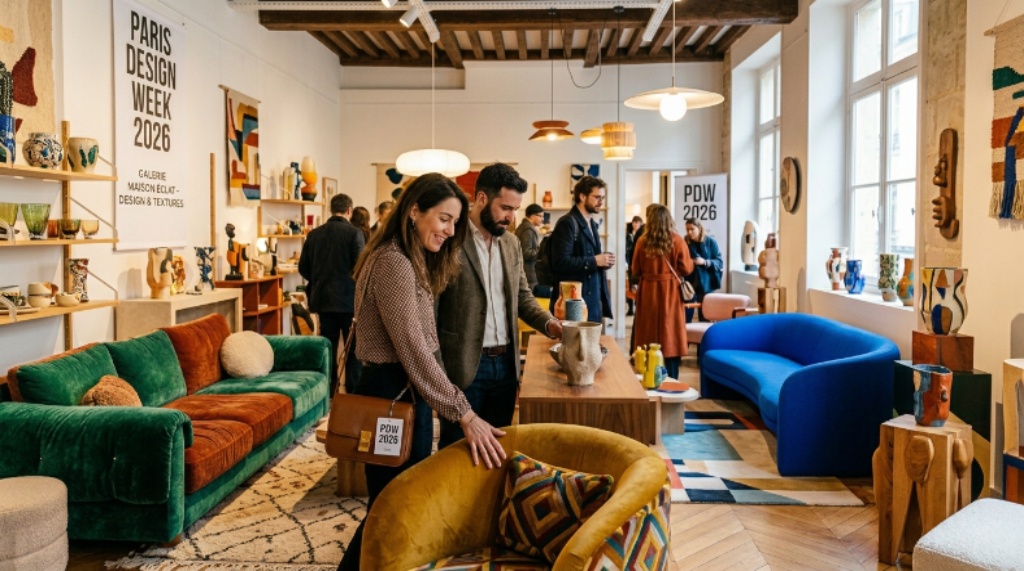
Every September, the city of Paris transforms. Showrooms throw open their doors. Galleries hang new works. Streets fill with designers, buyers, and curious visitors from across the globe. This is Paris Design Week, the annual city-wide celebration of home design, decoration, and creative innovation. The 2026 edition, running from September 10 to 19, has already made its mark. The trends born here are now spreading to interiors, studios, and design conversations around the world.
This article takes you inside the event. It covers the key themes, the most talked-about moments, and the design movements that are set to shape how we live and decorate in the years ahead.
What Makes Paris Design Week Different
Paris Design Week is not a single trade show. It is a ten-day city-wide event organized in close partnership with Maison&Objet, one of the world’s most respected design fairs. While Maison&Objet runs from September 10 to 14 at the Paris Nord Villepinte exhibition center, the broader design week stretches across the city through September 19. More than 200 venues participate each year, including galleries, concept stores, private showrooms, museums, and pop-up spaces throughout the city’s most design-rich neighborhoods.
This structure makes the event uniquely accessible. Professionals attend for business. Enthusiasts explore at their own pace. Students and emerging creatives find inspiration in unexpected corners. The result is a living, breathing design laboratory that belongs to everyone.
Additionally, Paris Design Week differs from other design events in one important way: it is deeply embedded in the city itself. The design is not contained behind exhibition walls. It spills into the streets, the arrondissements, and the everyday life of Paris.
The Theme Driving 2026: Pulse in Motion
Each edition of Maison&Objet is anchored by a central theme. For September 2026, that theme is Pulse in Motion. It was developed in collaboration with the Paris-based trend forecasting agency NellyRodi, and it captures the spirit of the moment well.
The theme speaks to energy, movement, and human connection. In a world increasingly dominated by screens and automation, the September 2026 edition is a call to feel again. It places emotion, texture, and bold creativity at the center of contemporary design.
The creative duo behind the theme’s visual identity is Masquespacio, a Valencia-based studio founded in 2010 by Colombian designer Ana Milena Hernandez and Belgian designer Christophe Penasse. They were appointed ambassadors of Maison&Objet Pulse and Paris Design Week in September 2026, unveiling a vibrant, color-rich vision of tomorrow’s design through two installations presented both at the fair and across the city.
Their approach is bold and unapologetic. In one interview, Hernandez described their vision simply: “More emotion, more color, more of everything.” This sensibility runs through every corner of the 2026 edition and sets the tone for the trends that have followed.
The Return of Craft: Making Things by Hand Again
One of the clearest signals from the 2026 edition is a powerful return to handmade craft. This is not nostalgia for its own sake. It is a deliberate response to the speed and sameness of mass production. Across showrooms and galleries, visitors encountered objects made with patience, skill, and deep respect for materials.
De Le Cuona leaned into this key theme of the week with an installation featuring the short film True Luxury Takes Time, accompanied by a preview of the Woven Earth collection inspired by global landscapes ranging from Chinese rice paddies to American deserts and Incan trails. The collection explores how natural fibres become luxurious textiles through painstaking traditional processes. Sculptural seating and layered fabrics invited visitors to touch and engage rather than simply observe.
This hands-on quality is central to what makes craft-driven design so compelling right now. People are tired of surfaces that look beautiful in photographs but feel empty in person. Therefore, the move toward textured, handmade, and material-rich objects is not just an aesthetic choice. It is a response to a deeper cultural hunger for authenticity.
Fine Craft has become one of the most closely watched sectors at Maison&Objet. At the entrance of the Fine Craft sector, designer Elizabeth Leriche reimagines the future of the decorative arts, projecting craftsmanship into a desirable future. Her installation invites visitors to see traditional artisanal skill not as a relic of the past, but as one of design’s most promising frontiers.
Bold Color Takes Over
If 2025 belonged to the neutrals, 2026 is definitively the year of color. Across both the Maison&Objet fair and the wider Paris Design Week showrooms, saturated, confident color choices dominated the conversation.
Rich, saturated colors and boldly scaled patterns were impossible to miss across the textile halls of Maison&Objet and throughout Parisian showrooms. From unapologetic prints to whimsical, hand-stitched embroidery, textiles took on a new sense of confidence, signaling a clear shift toward more expressive and indulgent interiors.
This does not mean that neutral tones have disappeared. However, their role has shifted. Neutrals remain an important counterpoint, but they are now being used to frame and temper vivid moments rather than define the space themselves. In practice, this means a deep terracotta wall paired with soft linen, or a bold emerald sofa against a pale plaster backdrop. The neutral provides breathing room for the color to speak.
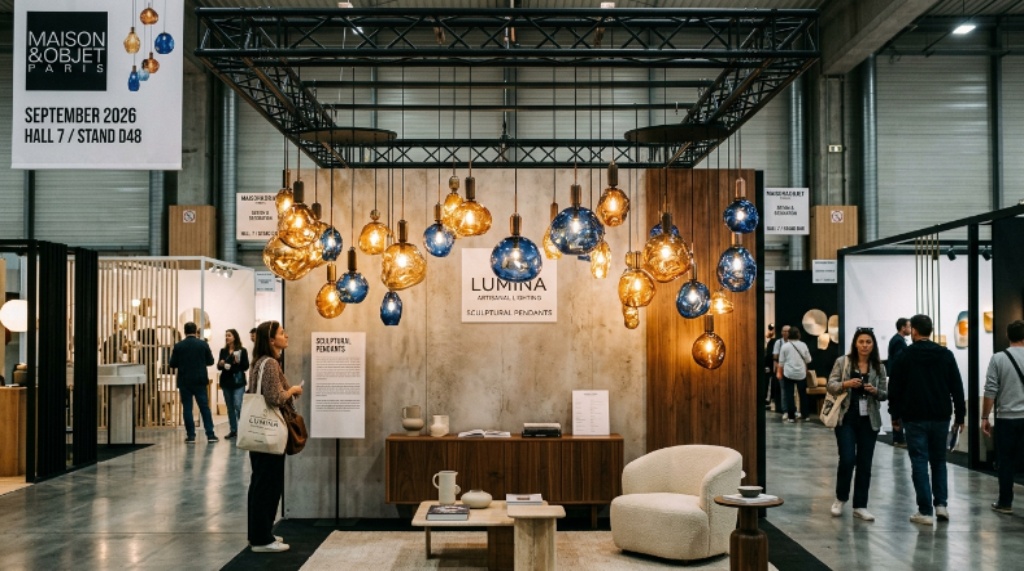
Lighting also embraced this chromatic confidence. Color was not used sparingly or as an accent in lighting, but as an integral part of a fixture’s identity. This lighting trend feels playful and atmospheric, capable of transforming a space through tone and mood as much as illumination. Expect to see more richly colored glass pendants, gradient-toned lamp shades, and sculptural fixtures in unexpected hues in the seasons ahead.
The Past as a Map for the Future
Alongside the bold new energy of Pulse in Motion, a quieter but equally powerful thread ran through the January edition of Paris Design Week. That edition, held in January 2026 at the Parc des Expositions Paris Nord Villepinte, centered on the theme Past Reveals Future.
The theme was a celebration of furniture rooted in craftsmanship, exploring how heritage informs contemporary design in furniture, decor, and innovation. More than 1,000 exhibitors presented their interpretations. The result was a fascinating dialogue between historical techniques and modern forms.
Studios such as Féau, Rinck, and Delisle embodied this shift, maintaining the precision and material richness that define their legacy but expressing it through cleaner lines and bolder forms that suit today’s spaces. This is not pastiche. It is a sophisticated reinterpretation, where centuries of French savoir-faire meet the sensibility of the present moment.
This approach is deeply resonant right now. In uncertain times, heritage provides stability and meaning. When it is expressed through contemporary form, it gives objects a sense of depth that purely trendy pieces cannot achieve.
Lighting Steps Into the Spotlight
Lighting emerged as one of the breakout categories of the 2026 editions. For years, lighting was treated as a functional afterthought in many interior schemes. That is changing rapidly.
Across showrooms and galleries, fixtures were treated less as functional necessities and more as bold, sculptural objects that anchor a room. The shift is meaningful. A light fitting is now as likely to be the focal point of a room as the furniture or the art on the walls.
Mixed materials played a key role in this transformation. Stone and metal featured prominently in both furniture and lighting, creating pieces that feel grounded yet striking. These materials highlighted a bold contrast between solidity and refined design. Together, they signaled a more experimental and tactile approach to modern opulence. These material combinations create objects with genuine presence, pieces that invite a second look and reward close inspection.
Textiles and the Quiet Art of Slowness
The textile halls of Maison&Objet have always been a reliable barometer of where interiors are heading. In 2026, they pointed clearly toward a renewed reverence for process and origin.
Textile design is being driven by a renewed respect for craftsmanship. Intricately woven jacquards and couture-level embroidery revealed how traditional techniques are being reintroduced with a lighter, more contemporary spirit.
Rubelli’s 2026 collection offered a compelling example of this approach. Titled Luce, meaning “light” in Italian, the collection takes inspiration from the behaviour of light, exploring its interaction with shape, colour and space, treating fabric as an active participant in its environment, filtering and reflecting light in captivating ways. This is fabric with a purpose beyond covering. It is material that changes a room by how it responds to its surroundings.
Additionally, global influences appeared frequently throughout the textile collections. Designers drew from craft traditions spanning Asia, South America, Africa, and Europe, weaving together a genuinely international vision of what luxury textiles can be.
Emerging Talent and the Next Generation of Design
Paris Design Week has always been a platform for new voices. In 2026, that commitment to emerging talent is stronger than ever.
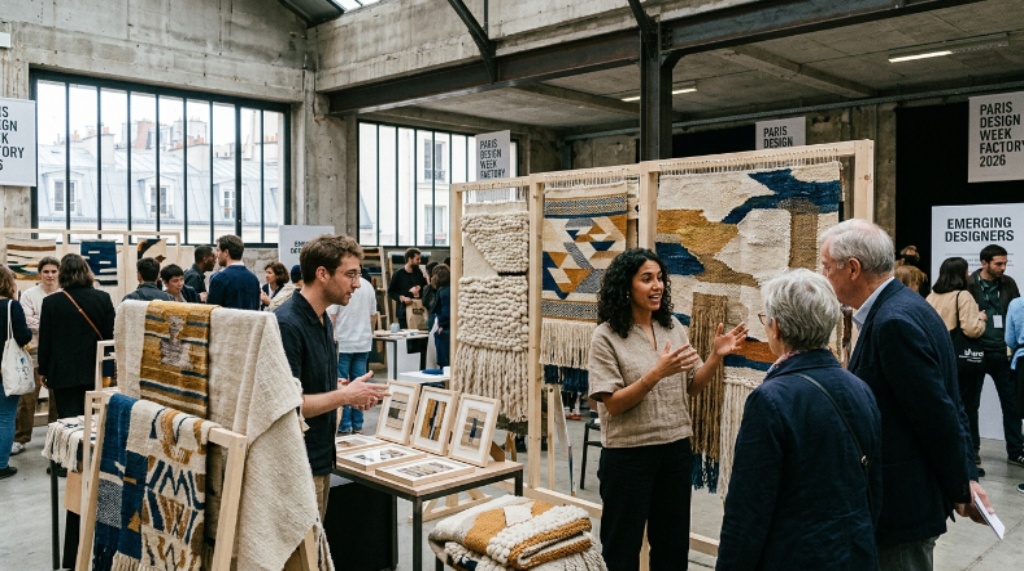
Paris Design Week Factory 2026 serves as a vital springboard for the avant-garde of design. Held in the iconic galleries of the Marais district, including Espace Commines and Galeries Joseph, the event attracts over 23,000 visitors including industry professionals, journalists, and trend hunters.
The Factory’s curated showcase is divided into four thematic exhibitions covering Collectible, Publishing, Craft, and a Special Focus on China. It offers designers with fresh prototypes and new ideas direct access to the people who matter in the global design ecosystem.
At Maison&Objet, the Rising Talent Awards highlight seven emerging young designers selected by a prestigious jury. The Future On Stage program serves as a springboard for companies under three years old. It supports innovative brands that are ready to bring their products to market.
These programs matter because they ensure that the event remains forward-looking. The trends set in Paris today do not come only from established houses. They come from young designers working in small studios who are willing to take risks and question assumptions.
Design District: A Fair Within the Fair
One of the most exciting developments at September 2026’s Maison&Objet is the return of the Design District, now in its second year. Driven by the artistic direction of the Hall Haus collective, the Design District establishes itself as an incubator of creative energy, described as a true observatory of tomorrow’s trends, a “show within the show.”
The Design District operates as a focused, curated environment within the larger fair. It brings together designers and brands whose work is pushing the boundaries of what contemporary design can be. For visitors who want to find what is next rather than what is now, this is the essential destination.
How These Trends Travel Beyond Paris
The influence of Paris Design Week does not stay in Paris.Trends seen in Parisian showrooms each September move quickly into luxury retail collections by the next spring. Within a year, those same ideas influence hospitality interiors and design concepts. Over the next two to three years, they gradually reach mainstream retail markets.
The mechanisms of influence have accelerated in recent years. Design media covers the event in real time. Social platforms carry images of new collections to audiences around the world within minutes of a showroom opening. Buyers and interior designers who attend return to their home countries carrying swatches, photographs, and purchasing orders.
Therefore, the trends of 2026 are already on their way to homes, hotels, and offices from Dubai to Seoul to São Paulo. The color confidence, the craft revival, the sculptural lighting, and the dialogue between past and present are not limited to France. They are genuinely global.
Conclusion
Paris Design Week 2026 has delivered one of its most energetic and coherent editions in years. Running across ten days in September, with the closely linked January edition setting the scene earlier in the year, the event has produced a clear picture of where design is heading. The Pulse in Motion theme, brought to life by Masquespacio and developed with NellyRodi, pushed for more emotion, more color, and more human connection in design. Craft emerged as a defining value, with handmade techniques and natural materials celebrated across furniture, textiles, and decorative objects. Bold, saturated color displaced the dominance of neutrals, while lighting stepped forward as a sculptural and mood-defining element in its own right.
Heritage and archival references were reimagined for contemporary spaces, proving that the past remains one of design’s richest sources of inspiration. Emerging talent programs at the Design District and Paris Design Week Factory ensured that fresh voices were part of the conversation. From Paris, these ideas are already on their way around the world, quietly reshaping how interiors will look and feel in the years ahead.
Frequently Asked Questions
When does Paris Design Week 2026 take place?
Paris Design Week 2026 runs from September 10 to 19, 2026. The Maison&Objet fair, which is the central anchor of the week, takes place from September 10 to 14 at the Paris Nord Villepinte exhibition center. Events across the city’s showrooms, galleries, and concept stores continue through September 19.
What is the theme of Paris Design Week 2026?
The September 2026 edition of Maison&Objet is themed Pulse in Motion. Developed with trend forecasting agency NellyRodi and brought to life by ambassador studio Masquespacio, the theme celebrates energy, movement, bold creativity, and human connection in design.
Who can attend Paris Design Week and Maison&Objet?
Maison&Objet is primarily a trade fair, meaning it is designed for design professionals, buyers, retailers, and interior designers. However, many events within the broader Paris Design Week program are open to the general public. Showrooms, gallery openings, workshops, and pop-up installations throughout the city are accessible to design enthusiasts without a professional credential.
What were the biggest design trends at the 2026 edition?
The standout trends showed a strong return to handmade craft and artisanal techniques. Designers embraced bold, saturated colors across textiles and lighting. Sculptural fixtures emerged as striking focal points in many spaces. There was also a refined blend of mixed materials and a balance between heritage design and contemporary form.
How do trends from Paris Design Week influence global interiors?
Trends from Paris Design Week spread quickly through design media, trade publications, and social platforms. Buyers and interior designers who attend the event carry influences back to their clients and projects around the world. Typically, trends appear in luxury retail within six months, hospitality interiors within a year, and broader consumer markets within two to three years.
Get Directions Using Google Maps:
